Thérèse never stood on Joan's battlefield. She recognized it anyway — and spent her short life fighting the same war by other means.
When Thérèse Martin was still a girl, she read the heroines of France. Joan of Arc was not yet a saint — only Venerable, and in Thérèse's childhood not even that. But the reading did what vocations do. She felt, she later wrote, the same burning zeal, the same heavenly inspiration. Then came a grace she counted among the greatest of her life: her glory would not be visible. It would consist in becoming a great saint.
That is the hinge of the Combined Hearts. Joan's glory was public, then stripped, then given back by the Church. Thérèse's was hidden from the first. Both were young French virgins. Both died with the name of Jesus close to their last breath. Both were given, in Thérèse's phrase, a heart of fire and a warrior's soul in a timid body.
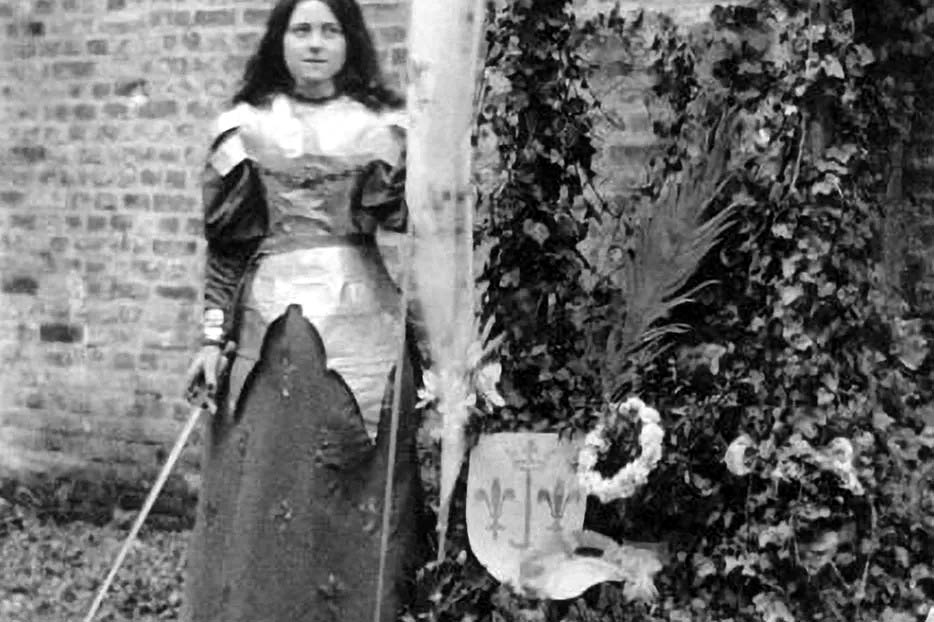
Thérèse as Joan, and Céline as St. Catherine — Carmel of Lisieux, 1895. The only photographs of a canonized saint playing another saint.
The year of Joan
1894 was France's year of Joan of Arc. On 27 January, Leo XIII declared her Venerable. Thérèse had already written her first play, performed on 6 January for her sister Mother Agnes: The Mission of Joan of Arc, or The Shepherdess of Domrémy Listening to Her Voices. She played Joan. The script already sounds like the Little Way. Joan wants to remain very little and very humble, so that Jesus will dwell in her.
On 8 May — the day proposed as a national holiday for the Maid, the anniversary of Orléans — Thérèse wrote her Canticle to Obtain the Canonization of Joan of Arc, dedicated to Céline. It is not a patriotic hymn only. "Sweet martyr, our monasteries are yours. You know well that virgins are your sisters, and like you the object of their prayers is to see God reign in every heart." Then the plea that became the second mission: "Come down to us, come convert France. Come save her a second time."
A year later, on 21 January 1895, the Carmel performed the longer play: Joan of Arc Accomplishing Her Mission — victories, captivity, martyrdom, heavenly triumph. Céline photographed Thérèse five times in the sacristy courtyard, a gold-paper costume over the Carmelite habit, brown wig, sword. In one image she is Joan in chains. Thérèse was twenty-two. She had two years to live.
Instead of voices from Heaven inviting me to combat, I heard in the depths of my soul a gentler and stronger voice… calling me to other exploits, to more glorious conquests, and into Carmel's solitude.
The dungeon
In 1897 the identification became almost unbearable. Thérèse was dying. She was also in what she called a dark tunnel: Heaven, which had consoled her from childhood, became a subject of conflict and torture. She wrote the poem To Joan of Arc. Joan in the black dungeon, laden with chains, with no friend to wipe her tears, seemed to her more radiant than at the king's coronation. The light was brought upon her by betrayal.
A hoaxer, Léo Taxil, had already used a retouched photograph of Thérèse as Joan. The humiliation of being displayed, the sense that even a gift could be turned — she placed it beside Joan's prison. Suffering, she wrote, is our treasure, but only because the God of love came looking for betrayal and death first.
Named together
Joan was canonized in 1920; Thérèse in 1925. The day after Thérèse's canonization, Pius XI told French pilgrims she was "a new Joan of Arc." In 1944, with France again under occupation, Pius XII named Thérèse secondary patron of France, equal in that honor to Joan. The Combined Hearts is not an official title of the Church. It is a name for what the Church had already joined: two patrons, one country, one desire — that God reign in every heart.